The History of Astronomy: A Journey Through Time
Welcome to Galactic Guidance, your trusted source for exploring the cosmos. Astronomy, the scientific study of celestial objects and phenomena, is one of humanity’s oldest pursuits, weaving together curiosity, innovation, and discovery. From ancient stargazers to modern space telescopes, the history of astronomy reflects our quest to understand the universe. In this comprehensive guide, we’ll trace its evolution, highlight key milestones, and offer insights for beginners eager to connect with the stars.
This article dives into astronomy’s origins, pivotal moments, and modern advancements, enriched with Galactic Guidance-branded visuals to bring the journey to life. Whether you’re new to astronomy or a seasoned enthusiast, you’ll find inspiration in how humanity has unraveled cosmic mysteries. For a beginner’s overview, visit our What is Astronomy? A Beginner’s Guide.
Ancient Beginnings: Stargazing in Early Civilizations
Caption: A Galactic Guidance infographic depicting ancient astronomical tools and observations.
Astronomy’s roots stretch back to prehistoric times. Early humans observed the sky to track seasons, navigate, and mark time. By 3000 BC, Mesopotamians, including the Babylonians, recorded celestial events on clay tablets, noting eclipses and planetary cycles. Their star catalogs, like the MUL.APIN, laid foundations for systematic observation.
In Egypt, around 2500 BC, the alignment of pyramids with cardinal points and stars like Sirius reflected astronomical knowledge used for agriculture and religion. Stonehenge, built around the same period in Britain, aligned with solstices, serving as a celestial calendar.
Ancient Chinese astronomers documented supernovae and comets as early as 1054 BC, while the Maya in Mesoamerica created precise calendars by 300 BC, predicting Venus’s cycles. These civilizations show astronomy’s universal appeal, blending science with culture.
For more on ancient observatories, check our Ancient Skywatchers Guide. The British Museum’s Astronomy Archives offer external insights.
Classical Astronomy: Greek and Hellenistic Contributions
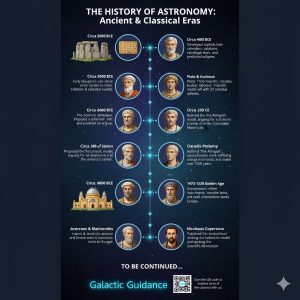
The History of Astronomy: A Journey Through Time
Caption: A Galactic Guidance diagram illustrating Greek astronomical models.
By 600 BC, ancient Greece advanced astronomy with philosophy and mathematics. Thales of Miletus predicted a solar eclipse in 585 BC, a milestone in predictive astronomy. Pythagoras proposed a spherical Earth, while Aristarchus of Samos suggested a heliocentric model around 280 BC, though it was overlooked.
Aristotle’s geocentric model, with Earth at the universe’s center, dominated for centuries. Ptolemy’s Almagest (150 AD) refined this, using epicycles to explain planetary motion. His work influenced astronomy until the Renaissance.
Greek advancements spread through the Hellenistic world, preserved by Islamic scholars like Al-Battani, who improved star catalogs in the 9th century. Learn more in our Greek Astronomy Legacy. The Library of Congress hosts Ptolemy’s texts.
The Renaissance Revolution: A New Cosmic Perspective
![Galactic Guidance Renaissance Astronomy Collage]
Caption: A Galactic Guidance collage of Renaissance astronomers and their tools.
The Renaissance (14th–17th centuries) reshaped astronomy. In 1543, Nicolaus Copernicus published De Revolutionibus, proposing a heliocentric model with the Sun at the center. This challenged the Church’s geocentric doctrine, sparking debate.
Galileo Galilei’s 1609 telescope observations—Jupiter’s moons, Venus’s phases, and lunar craters—supported Copernicus. His work, detailed in Sidereus Nuncius, faced resistance but marked a shift to observational science. Johannes Kepler’s laws of planetary motion (1609–1619) described elliptical orbits, refining heliocentrism.
Isaac Newton’s 1687 Principia Mathematica introduced universal gravitation, explaining why planets orbit. These breakthroughs laid the groundwork for modern astronomy. Explore our Renaissance Astronomy Guide or visit NASA’s History Page.
The Age of Exploration: Telescopes and New Worlds
![Galactic Guidance Telescope Evolution Infographic]
Caption: A Galactic Guidance infographic tracing the development of telescopes.
The 18th and 19th centuries expanded astronomy through improved telescopes. In 1781, William Herschel discovered Uranus, the first planet found with a telescope, and cataloged thousands of nebulae. His sister, Caroline Herschel, identified comets, contributing significantly.
In 1846, Johann Galle and Urbain Le Verrier discovered Neptune using mathematical predictions, showcasing astronomy’s growing precision. Advances in spectroscopy allowed scientists like Joseph Fraunhofer to analyze starlight, revealing chemical compositions.
Photography revolutionized observations, capturing images of faint objects. Observatories like Greenwich and Lick became hubs for discovery. Our Telescope Evolution Guide details these tools. The Royal Astronomical Society offers historical records.
The Modern Era: Expanding the Universe
![Galactic Guidance Modern Astronomy Milestones]
Caption: A Galactic Guidance timeline of 20th- and 21st-century astronomy breakthroughs.
The 20th century transformed astronomy into a global science. Albert Einstein’s 1915 theory of relativity redefined space-time, influencing cosmology. In 1929, Edwin Hubble proved the universe is expanding, supporting Georges Lemaître’s Big Bang theory (1927).
The space age began with Sputnik in 1957, followed by missions like Apollo and Voyager. The Hubble Space Telescope (1990) captured unprecedented images of galaxies, nebulae, and exoplanets. The James Webb Space Telescope (2021) peers into the early universe, revealing star formation.
Radio astronomy, pioneered by Karl Jansky in the 1930s, detected cosmic signals, while Vera Rubin’s 1970s work on galaxy rotation provided evidence for dark matter. Astrobiology emerged, searching for life on Mars and exoplanets.
Stay updated with our Latest Astronomy News. The Space Telescope Science Institute covers Hubble and Webb.
Key Figures in Astronomy’s History
![Galactic Guidance Astronomers Portrait Collage]
Caption: A Galactic Guidance collage featuring iconic astronomers.
Astronomy owes much to its pioneers:
-
Nicolaus Copernicus: Introduced heliocentrism.
-
Galileo Galilei: Pioneered telescope use.
-
Johannes Kepler: Defined planetary orbits.
-
Isaac Newton: Explained gravity.
-
Edwin Hubble: Proved universal expansion.
-
Vera Rubin: Evidenced dark matter.
-
Carl Sagan: Popularized astronomy via Cosmos.
Explore their stories in our Famous Astronomers Series. The American Museum of Natural History features exhibits.
Astronomy Today: The Future of Cosmic Exploration
Today, astronomy pushes boundaries. The Event Horizon Telescope captured the first black hole image in 2019. Missions like TESS hunt for exoplanets, with thousands discovered. Citizen science platforms like Zooniverse involve amateurs in classifying galaxies.
Future projects include the Vera C. Rubin Observatory, set to map the sky in unprecedented detail by 2025. Space tourism and private ventures like SpaceX expand access to space. Our Future of Astronomy covers trends, and BBC Sky at Night offers updates.
Getting Started as a Beginner
![Galactic Guidance Stargazing Starter Guide]
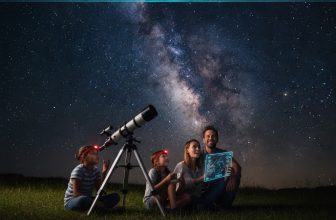
Caption: A Galactic Guidance artwork of a beginner stargazing with a telescope.
Astronomy’s history inspires action. Start by:
-
Observing constellations with a planisphere or app like Stellarium.
-
Visiting dark-sky sites—find them via our Dark Sky Locations.
-
Joining clubs through the International Astronomical Union.
-
Reading “Turn Left at Orion” for practical tips.
Our Stargazing Calendar lists events like meteor showers.
Conclusion: Your Place in Astronomy’s Story
Astronomy’s history is a testament to human curiosity, from ancient star charts to space telescopes. Galactic Guidance invites you to join this legacy. Step outside, look up, and start observing. Subscribe for more guides and explore our Astronomy Basics.
Meta Description: Discover the history of astronomy with Galactic Guidance. From ancient stargazers to modern telescopes, explore key milestones and start your cosmic journey. (147 characters)