Black Holes: What They Are and How They Form
Welcome to Galactic Guidance, your trusted source for unraveling the mysteries of the cosmos. Black holes, some of the universe’s most enigmatic objects, captivate imaginations with their immense gravity and invisible presence. This beginner-friendly guide explores what black holes are, how they form, their impact on the universe, and how scientists study them. Optimized for Yoast SEO and tailored for the Galactic Guidance brand, this article offers a clear introduction to these cosmic wonders.
No telescope is required to appreciate black holes, though observing their effects requires advanced tools. For more on naked-eye astronomy, check our How to Observe Stars Without a Telescope. Let’s dive into the fascinating world of black holes!
What Are Black Holes?
Black holes are regions in space where gravity is so strong that nothing—not even light—can escape. This extreme gravitational pull is caused by a massive concentration of matter packed into a tiny area, forming a point called a singularity. Surrounding the singularity is the event horizon, the boundary beyond which escape is impossible.
Black holes vary in size and type:
- Stellar-Mass Black Holes: Formed from collapsed stars, typically 3–20 times the Sun’s mass.
- Supermassive Black Holes: Found at galaxy centers, with masses millions to billions of times the Sun’s (e.g., Sagittarius A* in the Milky Way).
- Intermediate Black Holes: Rarer, with masses between stellar and supermassive (100–100,000 solar masses).
- Primordial Black Holes: Hypothetical small black holes from the early universe.
Their invisibility makes them detectable only through their gravitational effects or emitted radiation. For more on cosmic objects, visit our Understanding the Night Sky: What is Astronomy? A Beginner’s Guide. The NASA Black Hole Page provides detailed explanations.
How Black Holes Form
Black holes form through dramatic cosmic events, primarily involving stellar evolution:
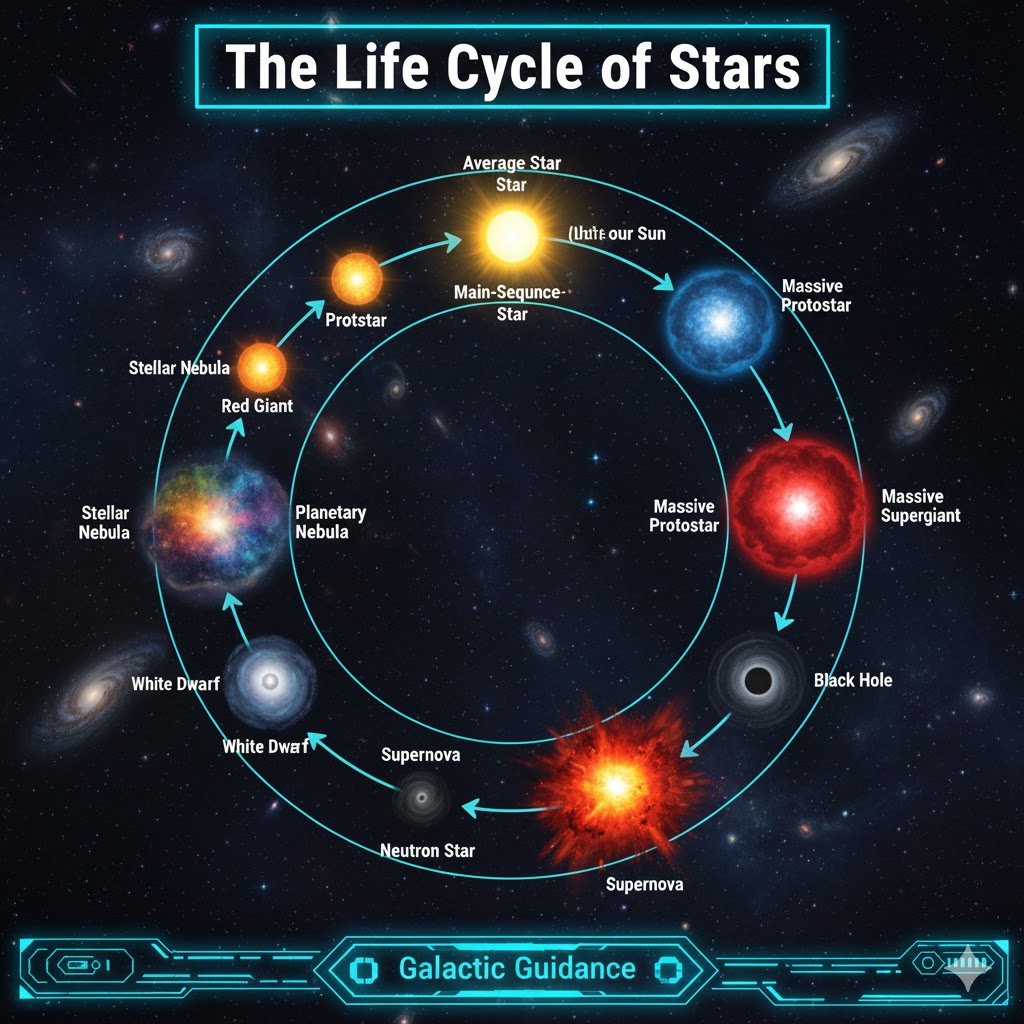
- Stellar-Mass Black Holes: These begin with massive stars (at least 8–10 times the Sun’s mass). After burning through their fuel, these stars undergo a supernova explosion, expelling outer layers. If the core remains massive enough (above ~3 solar masses), it collapses under its own gravity into a black hole. This process can take millions to billions of years.
- Supermassive Black Holes: Their formation is less certain. Theories suggest they grow from stellar-mass black holes merging over billions of years or form directly from massive gas clouds in the early universe. Evidence shows they existed when the universe was young, hinting at rapid growth.
- Intermediate Black Holes: These may form from collisions of smaller black holes or the collapse of massive star clusters.
- Primordial Black Holes: If they exist, they likely formed moments after the Big Bang due to density fluctuations, though this remains unproven.
Our The History of Astronomy covers early cosmic theories, and NASA’s Formation Page details current research.
The Science Behind Black Holes
Black holes bend space and time, a concept from Albert Einstein’s 1915 theory of general relativity. This theory describes gravity as the warping of spacetime by mass. Near a black hole, this warping is extreme, creating a “gravitational well” that traps everything within the event horizon.
Key features include:
- Singularity: A point of infinite density where physics as we know it breaks down.
- Accretion Disk: Material spiraling into a black hole heats up, emitting X-rays detectable by telescopes.
- Jets: High-energy streams of particles ejected from the poles of some black holes.
Our Introduction to Astrophysics explains these phenomena, and the European Space Agency offers insights.
How Scientists Detect Black Holes
Since black holes don’t emit light, detection relies on indirect methods:
- Gravitational Effects: Black holes influence nearby stars or gas, causing orbital irregularities. For example, stars near Sagittarius A* move at high speeds, suggesting a supermassive black hole.
- Accretion Disk Radiation: X-ray telescopes like Chandra detect hot gas spiraling into black holes.
- Gravitational Waves: Merging black holes create ripples in spacetime, detected by LIGO since 2015.
- Event Horizon Telescope: In 2019, this global network captured the first image of a black hole’s shadow in galaxy M87.
For observation tips, see our Understanding the Night Sky: Constellations 101. The Event Horizon Telescope shares imaging details.
The Role of Black Holes in the Universe
Black holes shape galaxies and the cosmos:
- Galaxy Formation: Supermassive black holes at galaxy centers influence star formation and galactic structure.
- Mergers: Black hole collisions, detected as gravitational waves, contribute to cosmic evolution.
- Energy Output: Accretion disks and jets affect surrounding space, regulating star birth.
Some theories suggest black holes might connect to other universes via wormholes, though this is speculative. Our Latest Astronomy News covers recent findings, and NASA’s Universe Page explores their role.
Observing Black Holes Indirectly
Beginners can’t see black holes directly, but their effects are observable:
- Star Motion: Watch stars near galactic centers (e.g., Sagittarius A*) via time-lapse videos online.
- Meteor Showers or Transients: Rare events like gamma-ray bursts from black hole activity may inspire further interest.
- Tools: Use apps like Stellarium to locate regions with known black holes, though visual confirmation needs telescopes.
Enhance your experience with our Best Dark Sky Locations or Beginner Stargazing Tools. Sky & Telescope offers viewing guides.
Tools for Learning About Black Holes
While observation is indirect, these tools aid understanding:
- Astronomy Apps: Star Walk or SkySafari show black hole locations.
- Binoculars: Useful for spotting bright stars near black hole regions.
- Books: “Black Holes” by Kip Thorne offers a beginner-friendly read.
- Online Resources: NASA and ESA sites provide simulations.
Overcoming Observation Challenges
Stargazing hurdles include:
- Light Pollution: Seek dark sites using Light Pollution Map.
- Complexity: Focus on educational content rather than direct viewing.
- Weather: Check Clear Outside for clear nights.
- Comfort: Bring warm gear for long sessions.
Join clubs via the International Astronomical Union for support.
Modern Discoveries and Future Exploration
Recent breakthroughs include the 2019 M87 black hole image and LIGO’s gravitational wave detections. The James Webb Space Telescope (2021) studies black hole effects on early galaxies. Future missions like the Laser Interferometer Space Antenna (LISA, launching 2030s) will detect more waves.
Amateurs contribute via Zooniverse, analyzing black hole data. Stay updated with our Latest Astronomy News or BBC Sky at Night.
Getting Started with Black Hole Exploration
Start today:
- Learn Online: Explore NASA or ESA sites.
- Join a Community: Connect via our Join Our Community.
- Watch Events: Follow news on black hole discoveries.
Conclusion: Unveil the Cosmic Abyss
Black holes are gateways to understanding the universe’s extremes, from stellar collapse to galactic evolution. Galactic Guidance is here to guide your journey—subscribe for more tips and explore our Understanding the Night Sky: Constellations 101. Dive into the mystery of black holes and let the cosmos inspire you.