The Life Cycle of Stars
Welcome to Galactic Guidance, your trusted source for exploring the wonders of the cosmos. Stars, the brilliant beacons of the night sky, have life cycles that span millions to billions of years, shaping the universe as we know it. This beginner-friendly guide delves into the stages of a star’s life, from birth to death, and explains how these processes create elements essential for life. Optimized for Yoast SEO and tailored for the Galactic Guidance brand, this article offers a clear introduction to stellar evolution.
No telescope is needed to start appreciating stars—just a clear sky and curiosity. For more on observing the night sky, check our How to Observe Stars Without a Telescope. Let’s journey through the life cycle of stars!
What Are Stars and How Do They Form?
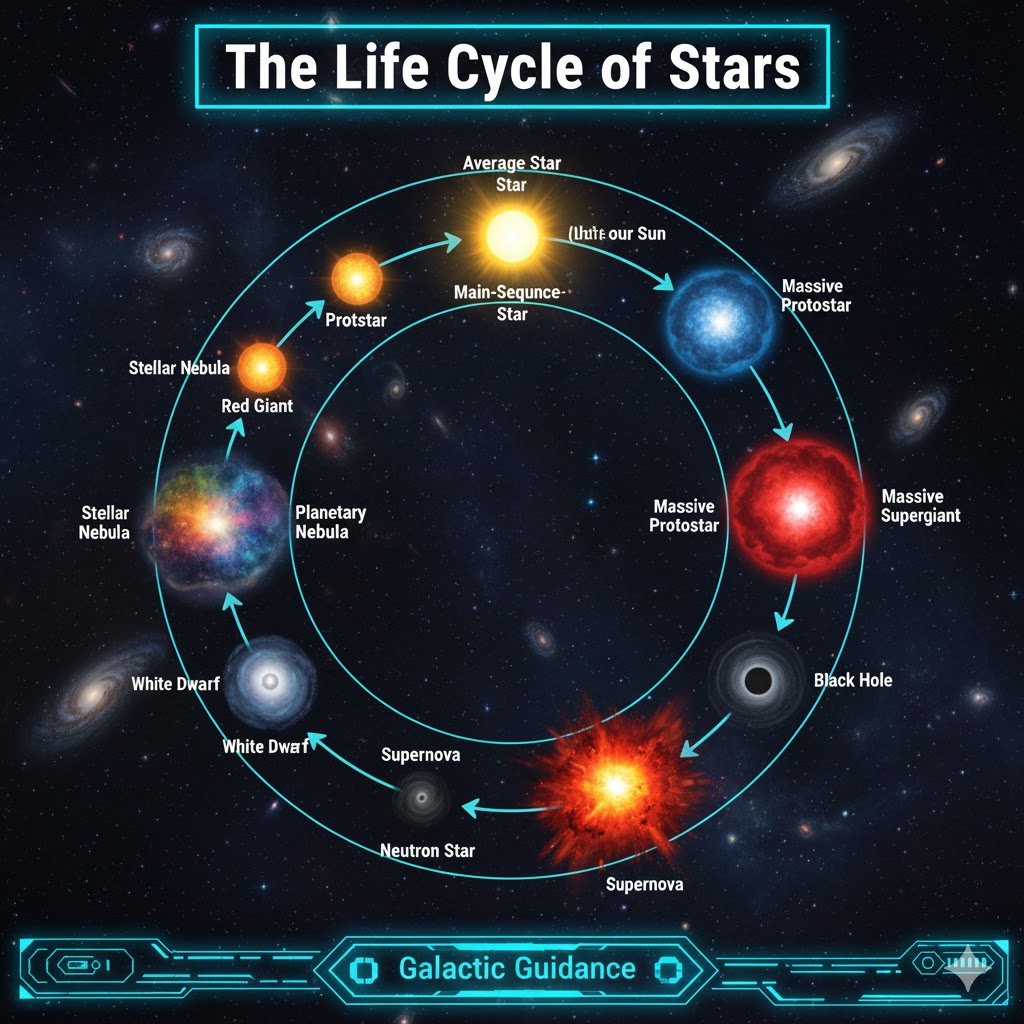
Stars are massive, glowing balls of plasma powered by nuclear fusion, converting hydrogen into helium to release energy. They form in nebulae, vast clouds of gas and dust, where gravity causes dense regions to collapse. This process, triggered by shockwaves from nearby supernovae or stellar winds, takes millions of years.
As the core heats to millions of degrees, fusion ignites, halting collapse and marking a star’s birth as a protostar. The Sun, a typical star, formed ~4.6 billion years ago from the solar nebula. For more on cosmic beginnings, visit our Understanding the Night Sky: What is Astronomy? A Beginner’s Guide. The NASA Star Formation Page provides details.
The Main Sequence: A Star’s Prime
Most of a star’s life—about 90%—is spent in the main sequence phase, where it fuses hydrogen into helium in its core. A star’s mass determines its lifespan and brightness:
- Low-Mass Stars (e.g., red dwarfs like Proxima Centauri): Live 100 billion years, burning fuel slowly.
- Medium-Mass Stars (e.g., the Sun): Live ~10 billion years, currently halfway through.
- High-Mass Stars (e.g., Rigel): Live only a few million years due to rapid fusion.
During this phase, stars like the Sun maintain equilibrium between gravity pulling inward and fusion pressure pushing outward. Our Introduction to Astrophysics explores this balance, and ESA’s Stellar Life Page offers insights.
The Evolution of Low- and Medium-Mass Stars
After exhausting hydrogen, low- and medium-mass stars (up to ~8 solar masses) evolve:
- Red Giant Phase: The core contracts, and the outer layers expand as helium fusion begins. The Sun will become a red giant in ~5 billion years, possibly engulfing inner planets.
- Planetary Nebula: The outer layers are ejected, forming a glowing shell, while the core becomes a white dwarf—a hot, dense remnant about Earth-sized, cooling over billions of years.
- White Dwarf Fate: If in a binary system, it may accrete matter and explode as a nova or, rarely, a Type Ia supernova if it exceeds the Chandrasekhar limit (~1.4 solar masses).
Our The History of Astronomy covers early stellar observations, and NASA’s Stellar Evolution details these stages.
The Evolution of High-Mass Stars
High-mass stars (above 8 solar masses) follow a more dramatic path:
- Supergiant Phase: After hydrogen depletion, they expand into red or blue supergiants (e.g., Betelgeuse), fusing heavier elements like carbon and oxygen.
- Supernova Explosion: The core collapses, then rebounds in a massive explosion, visible across the universe. This can outshine galaxies, scattering elements like iron and gold.
- Remnant: The core’s fate depends on mass:
- Neutron Star: A dense, spinning object (~1.4–3 solar masses), emitting pulses as a pulsar if rotating rapidly.
- Black Hole: If above ~3 solar masses, it collapses into a black hole (see Black Holes: What They Are and How They Form).
Our Latest Astronomy News tracks supernova events, and ESA’s Supernova Page explains explosions.
The Role of Stars in the Universe
Stars are cosmic factories:
- Element Creation: Fusion produces elements up to iron; supernovae forge heavier ones, seeding the universe with materials for planets and life.
- Galaxy Dynamics: Stellar life cycles influence galaxy evolution, with supernovae triggering new star formation.
- Black Hole Formation: High-mass star deaths contribute to black holes, shaping cosmic structure.
This process connects us to the stars, as our bodies contain stardust. Our Understanding Dark Matter explores related cosmic forces, and NASA’s Life Cycle Page highlights their impact.
Observing Stellar Life Cycles
Beginners can observe stars at various stages:
- Main Sequence Stars: Spot bright stars like Sirius or Vega with the naked eye.
- Red Giants: Identify reddish Betelgeuse or Aldebaran.
- Planetary Nebulae: Use binoculars for the Ring Nebula (M57).
- Supernova Remnants: View the Crab Nebula (M1) with a small telescope or images online.
Enhance your experience with our Best Dark Sky Locations or Understanding the Night Sky: Constellations 101. Sky & Telescope offers viewing tips.
Tools for Studying Stellar Evolution
Support your learning with these tools:
- Astronomy Apps: Stellarium or Star Walk show star types and nebulae.
- Binoculars: 7×50 models reveal nebulae or star clusters.
- Books: “Stellar Evolution” by Colin A. Ronan is beginner-friendly.
- Online Resources: NASA and ESA sites provide simulations.
Our Beginner Stargazing Tools offers gear advice.
Overcoming Observation Challenges
Stargazing hurdles include:
- Light Pollution: Use Light Pollution Map to find dark sites.
- Weather: Check Clear Outside for clear nights.
- Identifying Stages: Start with bright, obvious stars; apps help.
- Comfort: Bring warm clothes or a chair.
Join clubs via the International Astronomical Union for support.
Modern Discoveries and Future Exploration
Recent findings include the James Webb Space Telescope’s 2022 images of stellar nurseries. The Vera C. Rubin Observatory (2025) will track supernovae. Future missions may probe neutron stars or black hole formation.
Amateurs contribute via Zooniverse, classifying stellar data. Stay updated with our Latest Astronomy News or BBC Sky at Night.
Getting Started with Stellar Observation
Start tonight:
- Spot Bright Stars: Look for Sirius or Betelgeuse.
- Join a Community: Connect via our Join Our Community.
- Track Events: Use our Stargazing Calendar.
Conclusion: Journey Through Stellar Lives
The life cycle of stars—from nebulae to supernovae—shapes the universe and our existence. Galactic Guidance is here to guide your journey—subscribe for more tips and explore our Understanding Dark Matter. Step outside, gaze at the stars, and connect with their cosmic story.