How Planets Move in the Solar System: A Beginner’s Guide
Welcome to Galactic Guidance, your trusted source for unraveling the mysteries of the cosmos. The dance of planets across the night sky has fascinated humanity for centuries, sparking questions about how these celestial bodies move in our solar system. This beginner-friendly guide explores the mechanics of planetary motion, the laws governing it, and how you can observe these movements yourself. Optimized for Yoast SEO and tailored for the Galactic Guidance brand, this article provides a clear, engaging introduction to planetary orbits, their historical discovery, and practical tips for stargazers.
No advanced equipment is needed to start observing planets—just curiosity and a clear sky. For more on naked-eye astronomy, check our How to Observe Stars Without a Telescope. Let’s dive into the fascinating world of planetary motion and discover how planets move in the solar system.
Understanding Planetary Motion: The Basics
Planets in our solar system orbit the Sun, the central star, in predictable paths. These movements are governed by gravity and follow specific patterns described by scientific laws. The solar system includes eight planets—Mercury, Venus, Earth, Mars, Jupiter, Saturn, Uranus, and Neptune—each traveling in an elliptical orbit around the Sun.
Unlike stars, which appear fixed in constellations, planets seem to “wander” against the backdrop of stars, earning them the name “planets” from the Greek word for “wanderer.” Their motion includes orbiting the Sun and, in some cases, rotating on their axes, creating day-night cycles.
To learn more about the solar system’s structure, visit our Astronomy Basics. The NASA Solar System Exploration page offers detailed insights.
The Historical Journey to Understanding Planetary Motion
The path to understanding planetary motion was a scientific revolution. Ancient astronomers, like Ptolemy in 150 AD, proposed a geocentric model, placing Earth at the universe’s center with planets moving in complex loops called epicycles. This model dominated for centuries.
In 1543, Nicolaus Copernicus introduced the heliocentric model, with the Sun at the center and planets orbiting it. His work, detailed in De Revolutionibus, challenged prevailing views. Galileo Galilei’s 1609 telescope observations of Venus’s phases and Jupiter’s moons supported heliocentrism, despite resistance.
Johannes Kepler, in the early 17th century, refined this model with his three laws of planetary motion, describing elliptical orbits. Isaac Newton’s 1687 law of universal gravitation explained why planets follow these paths, tying their motion to gravity’s pull. These discoveries laid the foundation for modern astronomy.
For more on this history, explore our History of Astronomy or visit NASA’s History Page.
Kepler’s Laws of Planetary Motion
Johannes Kepler’s three laws are key to understanding how planets move:
-
Law of Ellipses: Planets orbit the Sun in elliptical paths, not perfect circles, with the Sun at one focus of the ellipse. This means planets are sometimes closer (perihelion) or farther (aphelion) from the Sun.
-
Law of Equal Areas: A planet sweeps out equal areas in equal times. When closer to the Sun, a planet moves faster; when farther, it slows down.
-
Law of Harmonies: The square of a planet’s orbital period (time to complete one orbit) is proportional to the cube of its average distance from the Sun. For example, Jupiter, farther from the Sun, takes longer to orbit than Mercury.
These laws apply to all planets and even moons or satellites. Our Introduction to Astrophysics explains these concepts further. The Planetary Society offers visual explanations.
Why Planets Move: The Role of Gravity
Isaac Newton’s law of universal gravitation explains the force behind planetary motion. Gravity, the attraction between masses, keeps planets orbiting the Sun. The Sun’s massive gravity pulls planets inward, while their forward motion creates a balanced orbit. This dynamic also governs moons orbiting planets, like Earth’s Moon or Jupiter’s Galilean moons.
Planets also rotate on their axes, causing day and night. Earth’s 24-hour rotation is typical, but Venus rotates slowly (243 Earth days), and Uranus spins on its side. These variations add diversity to planetary motion.
For more on gravity’s role, see our Astronomy Basics. NASA’s Gravity Page provides a clear overview.
Observing Planetary Motion Without a Telescope
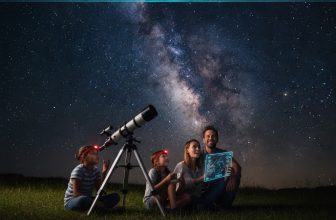
Planets are bright and visible to the naked eye, making them perfect for beginners. Here’s how to observe their motion:
-
Identify Planets: Planets don’t twinkle like stars. Look for bright, steady lights. Venus (evening/morning star), Jupiter, and Saturn are easiest to spot.
-
Track Movement: Planets shift against the star background over days or weeks, a phenomenon called retrograde motion when they appear to reverse direction due to Earth’s orbit. For example, Mars’s retrograde loop is noticeable over months.
-
Best Times: Observe after sunset or before dawn during a new moon for darker skies. Apps like Stellarium or SkySafari show planet positions.
-
Key Targets:
-
Venus: Brightest planet, visible near sunrise or sunset.
-
Jupiter: Bright, often near its moons (visible with binoculars).
-
Mars: Reddish hue, prominent during oppositions (when closest to Earth).
-
Our Top Celestial Sights lists viewing tips, and Sky & Telescope tracks planet visibility.
Tools for Observing Planetary Motion
While no telescope is needed, these tools enhance your experience:
-
Star Charts or Planisphere: Map planet positions for your date and location.
-
Astronomy Apps: Star Walk or Stellarium provide real-time planet tracking.
-
Binoculars: 7×50 or 10×50 models reveal Jupiter’s moons or Venus’s phases.
-
Notebook: Log planet sightings to observe their motion over time.
-
Red Flashlight: Preserves night vision for reading charts.
Check our Beginner Stargazing Tools or Sky & Telescope for gear recommendations.
Seasonal and Nightly Planetary Highlights
Planets’ visibility changes with Earth’s orbit. Key times include:
-
Oppositions: When a planet is opposite the Sun, it’s closest to Earth and brightest (e.g., Mars every ~2 years).
-
Conjunctions: Planets appear close together, like Venus and Jupiter pairings.
-
Seasonal Views:
-
Winter: Venus and Jupiter often dominate.
-
Summer: Saturn and Mars may shine.
-
Fall/Spring: Mercury is trickier but visible near twilight.
-
Our Stargazing Calendar lists events like oppositions. NASA’s Sky Events provides updates.
Overcoming Observation Challenges
Stargazing planets can have hurdles:
-
Light Pollution: Seek dark-sky sites using apps like Light Pollution Map. Our Best Dark Sky Locations helps.
-
Weather: Use apps like Clear Outside for clear sky forecasts.
-
Identifying Planets: Planets are brighter and steadier than stars. Apps confirm their positions.
-
Comfort: Bring warm clothes or a chair for long sessions.
Join astronomy clubs for guidance via the International Astronomical Union.
The Cultural and Scientific Impact of Planetary Motion
Understanding planetary motion has shaped science and culture. Ancient navigators used planets for direction, while myths tied them to gods (e.g., Mars as the war god). Kepler and Newton’s work revolutionized science, enabling space exploration. Today, missions like Voyager and Perseverance rely on these principles to explore distant worlds.
Our Famous Astronomers Series covers key figures. The American Museum of Natural History explores cultural impacts.
Modern Discoveries and Planetary Motion
Planetary motion studies continue to evolve. The Transiting Exoplanet Survey Satellite (TESS) uses orbital patterns to find thousands of exoplanets. Missions to Jupiter and Saturn reveal complex moon orbits. Citizen science platforms like Zooniverse let amateurs analyze orbital data.
Stay updated with our Latest Astronomy News or BBC Sky at Night.
Getting Started with Planetary Observation
Start observing planets tonight:
-
Find a Dark Sky: Use our Best Dark Sky Locations.
-
Spot Bright Planets: Look for Venus, Jupiter, or Mars.
-
Track Motion: Note a planet’s position nightly to see its path.
-
Join a Community: Connect via our Join Our Community or local clubs.
Conclusion: Follow the Planets’ Dance
Planetary motion is a captivating blend of science and wonder, from Kepler’s laws to the bright wanderers in your night sky. Galactic Guidance is here to guide your journey—subscribe for more tips and explore our Understanding the Night Sky: Constellations 101. Step outside, spot a planet, and marvel at the solar system’s cosmic dance.