What is Astronomy? A Beginner’s Guide
Welcome to Galactic Guidance, your go-to hub for exploring the wonders of the universe. If the twinkling stars, distant planets, or sprawling galaxies have ever sparked your curiosity, you’re in the right place. Astronomy, one of humanity’s oldest sciences, invites everyone to ponder the cosmos. But what exactly is astronomy? This beginner’s guide will walk you through its fundamentals, history, branches, tools, and practical tips to start your stargazing journey, all tailored with Galactic Guidance branding.
Astronomy is the scientific study of celestial objects, phenomena, and the universe beyond Earth’s atmosphere. It covers everything from our Sun and Moon to distant stars, galaxies, and the universe’s origins. Unlike astrology, which focuses on celestial influences on human life, astronomy uses observation, data, and physics to unravel cosmic mysteries.
For beginners, astronomy is approachable—you don’t need fancy gear to start. Just your eyes and a sense of wonder will do. As you dive deeper, tools like telescopes and apps can elevate your experience. At Galactic Guidance, we’re passionate about making astronomy accessible. Whether you’re seeking stargazing tips or cosmic news, this guide is your launchpad. For more, check our Stargazing Essentials.
Below, we’ll explore astronomy’s rich history, its diverse branches, essential tools, and actionable advice for newcomers. We’ll also highlight famous astronomers and recent discoveries, all infused with Galactic Guidance’s unique perspective. Let’s embark on this cosmic adventure!
The History of Astronomy: From Ancient Skies to Modern Marvels
![Galactic Guidance Timeline of Astronomy] Caption: A custom Galactic Guidance infographic showcasing key milestones in astronomy’s history.
Astronomy’s story spans millennia, rooted in humanity’s awe of the night sky. Ancient civilizations used the stars for navigation, agriculture, and rituals. Around 1000 BC, the Babylonians recorded eclipses and planetary movements, laying early foundations.
In ancient Greece, Aristotle’s geocentric model placed Earth at the universe’s center, a view that held for centuries. The Renaissance brought change: Nicolaus Copernicus’s 1543 heliocentric model put the Sun at the center, a radical shift. Galileo Galilei’s 1609 telescope observations of Jupiter’s moons and Venus’s phases supported this, challenging old beliefs.
The 17th century saw Johannes Kepler define elliptical planetary orbits and Isaac Newton explain orbits with gravity in 1687. By the 18th century, William Herschel discovered Uranus, and his sister Caroline found comets. In 1846, Neptune’s discovery via mathematical predictions marked a triumph.
The 20th century transformed astronomy. Albert Einstein’s 1915 relativity theory redefined space-time. Edwin Hubble’s 1929 observations confirmed the universe’s expansion, supporting the Big Bang theory. Space telescopes like Hubble (1990) and James Webb (2021) have since revealed distant galaxies and exoplanets.
Today, astronomy blends ancient curiosity with cutting-edge tech. Learn more in our Telescope Evolution Guide. For external insights, visit NASA’s History Archives.
This timeline shows astronomy’s evolution, inspiring beginners to connect with the stars.
Branches of Astronomy: A Universe of Possibilities

unnamed (1)
Caption: A Galactic Guidance-designed diagram highlighting astronomy’s main branches.
Astronomy is a tapestry of specialized fields, each offering unique perspectives on the cosmos. Here’s a breakdown for beginners:
-
Astrophysics: Applies physics to study star formation, black holes, and cosmic radiation. Subfields like cosmology explore the universe’s origins, while heliophysics examines the Sun’s activity.
-
Astrometry: Measures celestial positions and movements, vital for mapping the sky and detecting exoplanets.
-
Planetology: Studies planets, moons, and asteroids in our solar system and beyond.
-
Astrogeology: Analyzes the composition of celestial bodies, like Mars (areology) or the Moon (selenography).
-
Astrobiology: Searches for extraterrestrial life, studying habitable zones and potential biosignatures.
Radio astronomy detects invisible objects via radio waves, while observational astronomy focuses on telescope data. Dive deeper with our Astrophysics Primer or explore The Planetary Society for external resources.
These branches let beginners find their passion, from planets to cosmic life.
Tools and Equipment for Beginner Astronomers
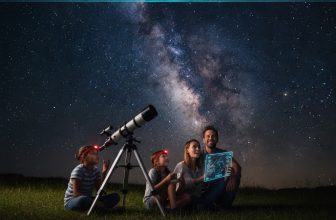
![Galactic Guidance Beginner Astronomy Kit] Caption: A Galactic Guidance illustration of a beginner’s telescope setup.
You don’t need a big budget to start astronomy. Here’s what you need:
-
Naked Eye: Learn constellations like Orion using star charts or apps like Stellarium.
-
Binoculars: Affordable for viewing Moon craters or star clusters.
-
Telescopes: Refractors for planets, reflectors for galaxies. Dobsonians are beginner-friendly with 4-6 inch apertures.
-
Mounts: Alt-azimuth for simple movement; equatorial for star tracking.
-
Accessories: Eyepieces for magnification, filters for light pollution.
-
Digital Tools: Planetarium apps or astrophotography adapters.
Safety Note: Never view the Sun without solar filters. Check our Telescope Buyer’s Guide or Sky & Telescope for gear tips.
These tools transform your backyard into a cosmic observatory.
How to Get Started with Astronomy: Tips for Newbies
![Galactic Guidance Stargazing Scene] Caption: A Galactic Guidance artwork of a family stargazing under the stars.
Ready to explore? Follow these steps:
-
Learn the Sky: Use a planisphere to spot Venus, Jupiter, or the Moon’s phases.
-
Find Dark Skies: Use apps like Light Pollution Map or join clubs via Royal Astronomical Society.
-
Observe Events: Track meteor showers (e.g., Perseids) or eclipses. Log sightings in a journal.
-
Study Up: Read “Astronomy: A Beginner’s Guide to the Universe” by Chaisson and McMillan or take Coursera courses.
-
Overcome Challenges: Be patient with weather and light pollution—use filters or travel.
Our Stargazing Calendar lists events. Consistency is key—start small and grow.
Famous Astronomers and Their Contributions
![Galactic Guidance Astronomers Collage] Caption: A Galactic Guidance collage featuring key astronomers.
Astronomy shines through its pioneers. Galileo’s telescope and Copernicus’s heliocentrism reshaped views. Carl Sagan’s “Cosmos” popularized science. Vera Rubin’s dark matter evidence, Henrietta Leavitt’s star measurements, and Jocelyn Bell Burnell’s pulsar discovery advanced the field.
Explore our Famous Astronomers Series or visit American Museum of Natural History.
Current Developments in Astronomy
The James Webb Space Telescope reveals early galaxies, while TESS hunts exoplanets. Amateurs contribute via Zooniverse. Stay updated with our Astronomy News or BBC Sky at Night.
Conclusion: Your Cosmic Journey Begins
Astronomy blends wonder and discovery. Galactic Guidance is your partner—subscribe for tips and join our community. Step outside tonight and let the stars inspire you. Visit our Astronomy Basics for more.