Understanding Dark Matter
Welcome to Galactic Guidance, your trusted source for unraveling the mysteries of the cosmos. Dark matter, an invisible force shaping the universe, remains one of science’s greatest enigmas. This beginner-friendly guide explores what dark matter is, how it influences galaxies, the evidence for its existence, and ongoing efforts to understand it. Optimized for Yoast SEO and tailored for the Galactic Guidance brand, this article provides a clear introduction to this elusive substance.
No telescope is needed to appreciate dark matter, though its effects are studied with advanced instruments. For more on observing the night sky, check our How to Observe Stars Without a Telescope. Let’s dive into the fascinating world of dark matter!
What Is Dark Matter?
Dark matter is a mysterious substance that cannot be seen or detected directly because it doesn’t emit, absorb, or reflect light. It’s estimated to make up about 27% of the universe’s mass-energy, compared to just 5% for ordinary matter (stars, planets, etc.). The remaining 68% is dark energy, another unknown.
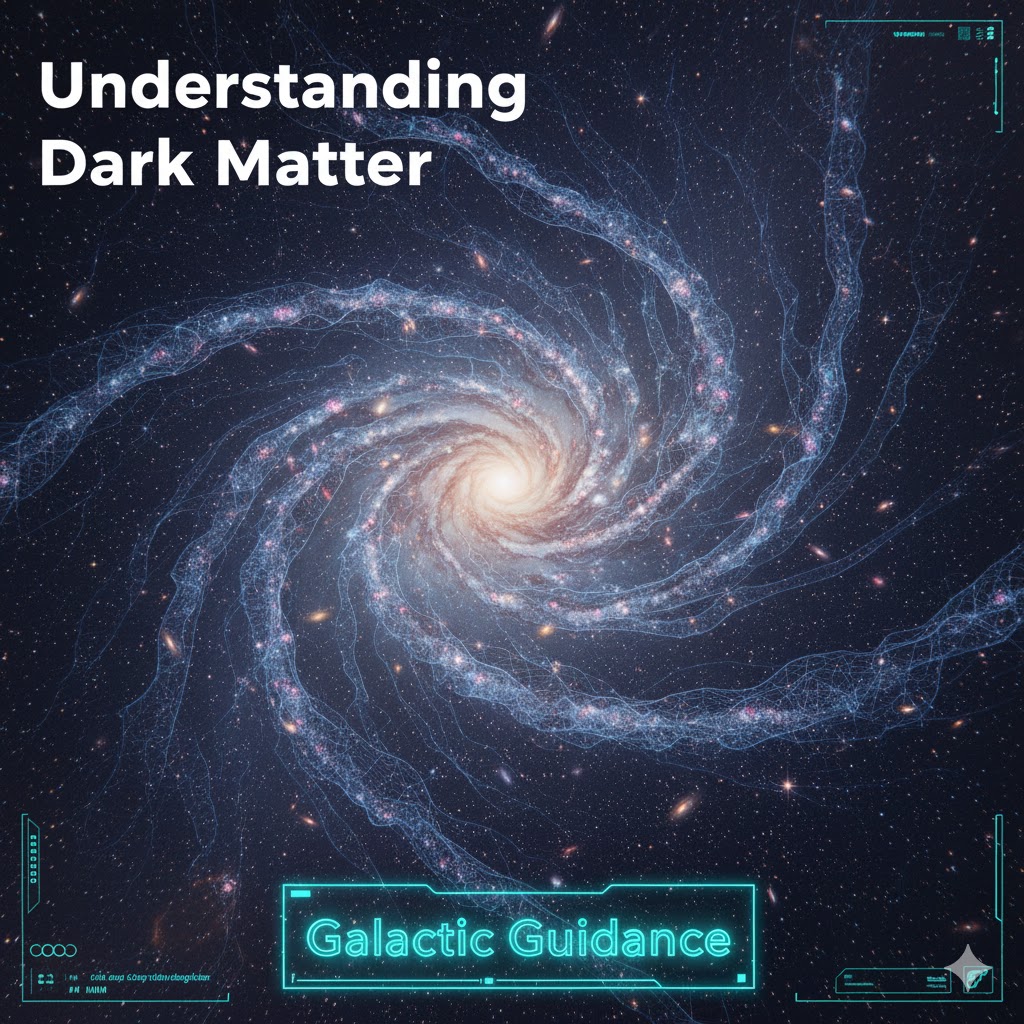
Unlike normal matter, dark matter interacts primarily through gravity, influencing the motion of galaxies and the universe’s structure. Its invisible nature makes it detectable only by its gravitational effects. For more on cosmic composition, visit our Understanding the Night Sky: What is Astronomy? A Beginner’s Guide. The NASA Cosmic Background Page offers a broader overview.
Evidence for Dark Matter
Scientists infer dark matter’s presence through several key observations:
- Galaxy Rotation Curves: Stars at a galaxy’s edge move faster than expected based on visible matter alone, suggesting unseen mass—dark matter—holds them in place.
- Gravitational Lensing: Light from distant galaxies bends around massive, invisible objects, creating distorted images. This effect, seen in galaxy clusters like the Bullet Cluster, points to dark matter.
- Cosmic Microwave Background (CMB): Tiny temperature fluctuations in the CMB, mapped by satellites like Planck, align with a universe containing dark matter.
- Galaxy Formation: Dark matter’s gravity helped structure the early universe, enabling galaxy formation.
Our Introduction to Astrophysics delves into these concepts, and NASA’s Dark Matter Page provides detailed evidence.
How Dark Matter Forms and Evolves
Dark matter’s origin is tied to the Big Bang, ~13.8 billion years ago. In the early universe, tiny density fluctuations grew under gravity’s influence. Ordinary matter clumped into stars and galaxies, but dark matter—unaffected by light or normal forces—formed a scaffold, guiding this process.
Unlike normal matter, dark matter doesn’t form atoms or emit radiation, so it doesn’t cool or collapse into dense objects. Instead, it creates vast halos around galaxies, influencing their shape and motion over billions of years. Our The History of Astronomy covers early cosmic theories, and ESA’s Planck Mission details CMB findings.
The Role of Dark Matter in the Universe
Dark matter plays a crucial role in cosmic evolution:
- Galaxy Structure: Its gravity holds galaxies together, preventing stars from flying apart.
- Cosmic Web: Dark matter filaments connect galaxy clusters, forming a vast network seen in simulations.
- Expansion Influence: Alongside dark energy, it shapes the universe’s expansion rate.
Some theories suggest dark matter particles (e.g., WIMPs—Weakly Interacting Massive Particles) could interact weakly, but this remains unproven. Our Latest Astronomy News tracks developments, and NASA’s Universe Page explores its impact.
How Scientists Study Dark Matter
Detecting dark matter is challenging due to its invisibility. Current methods include:
- Particle Detectors: Underground experiments like LUX-ZEPLIN search for rare dark matter particle collisions with normal matter.
- Telescope Observations: Surveys like the Dark Energy Survey and Euclid map gravitational lensing and galaxy distributions.
- Collider Experiments: The Large Hadron Collider (LHC) probes conditions that might produce dark matter particles.
- Simulations: Computer models test how dark matter affects cosmic structures.
For observation tips, see our Understanding the Night Sky: Constellations 101. The Dark Energy Survey shares findings.
Observing the Effects of Dark Matter
Beginners can’t see dark matter directly, but its effects are observable:
- Galaxy Shapes: Notice spiral or elliptical galaxies in photos, shaped by dark matter halos.
- Cluster Images: Online images of the Bullet Cluster show lensing effects.
- Tools: Use apps like Stellarium to locate galaxy clusters, though dark matter study requires professional data.
Enhance your experience with our Best Dark Sky Locations or Beginner Stargazing Tools. Sky & Telescope offers viewing guides.
Tools for Learning About Dark Matter
While observation is indirect, these tools aid understanding:
- Astronomy Apps: Star Walk or SkySafari show galaxy regions influenced by dark matter.
- Books: “The 4% Universe” by Richard Panek explains dark matter simply.
- Online Simulations: NASA and ESA sites offer interactive models.
- Binoculars: Useful for spotting bright galaxies like Andromeda.
Overcoming Study Challenges
Learning about dark matter can be complex:
- Abstract Nature: Focus on visible effects like galaxy motion or lensing images.
- Technical Data: Rely on simplified resources or our articles.
- Weather: Check Clear Outside for clear nights to view related objects.
- Comfort: Bring warm gear for stargazing sessions.
Join clubs via the International Astronomical Union for support.
Modern Discoveries and Future Exploration
Recent advances include the 2015 Planck satellite’s precise CMB map and LUX-ZEPLIN’s 2023 dark matter search results. The Euclid satellite (launched 2023) maps dark matter via lensing. Future experiments like the Deep Underground Neutrino Experiment (DUNE) may detect dark matter particles.
Amateurs contribute via Zooniverse, analyzing galaxy data. Stay updated with our Latest Astronomy News or BBC Sky at Night.
Getting Started with Dark Matter Exploration
Start today:
- Learn Online: Explore NASA or ESA sites.
- Join a Community: Connect via our Join Our Community.
- View Galaxies: Use apps to find Andromeda or the Milky Way.
Conclusion: Unravel the Invisible Force
Dark matter shapes the universe in unseen ways, from galaxy formation to cosmic expansion. Galactic Guidance is here to guide your journey—subscribe for more tips and explore our Black Holes: What They Are and How They Form. Dive into the mystery of dark matter and let the cosmos inspire you.