Betelgeuse: The Stellar Superstar in Orion’s Sky
Hey there, stargazer! Ready for a journey across the cosmos? Buckle up, because we’re heading to the iconic Betelgeuse—the fiery red supergiant that’s been lighting up the night sky for millions of years. If you’ve ever looked up and spotted the bright, red shoulder of the Orion constellation, you’ve been staring right at this cosmic giant. But Betelgeuse isn’t just your average twinkling star; it’s a stellar superstar with a reputation for being big, bold, and mysterious. So, let’s dive into everything that makes Betelgeuse one of the coolest stars in our universe!
What’s So Special About Betelgeuse?
First off, let’s clear up the basics. Betelgeuse (pronounced bee-tuhl-jooz) is a massive red supergiant star that lives in the Orion constellation—that’s the famous hunter you’ve probably seen during winter nights, with his three-starred belt and shoulder stars. It’s about 642 light-years away from Earth, so yeah, it’s pretty far—but it’s also one of the brightest stars we can see in the sky!
Now, why is Betelgeuse so special? It’s huge—we’re talking about a star 20 times more massive than our Sun! If you could somehow place Betelgeuse in the middle of our solar system, it would stretch past Mars and maybe even Jupiter. Big, right?
The Red Giant: Size, Color, and Coolness
So, here’s the scoop: Betelgeuse is red, and not just “hey, kinda reddish” red—it’s a glowing firetruck red that comes from its cool temperature (compared to other stars). Betelgeuse’s surface temperature is about 3,500°C—way cooler than our Sun’s hot, sizzling 5,500°C. That’s why it looks so distinctly red instead of yellow or white like other stars.
And we’re not just talking about size here. Betelgeuse is a supergiant, which means it’s nearing the end of its life, and it’s stretched out into an incredibly large ball. Imagine how much bigger it is than the Sun! But even though it’s massive, it’s not very dense. The star’s outer layers are so spread out that its gravity is much weaker than the Sun’s—meaning that if you were standing on Betelgeuse (if that were possible—don’t try this at home!), you’d be light as a feather.
Betelgeuse’s Future: Countdown to Supernova
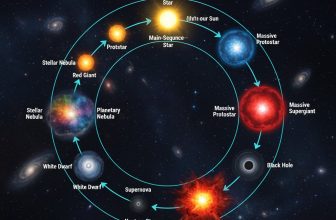
Hold on tight—this is where things get dramatic. Betelgeuse, as big and brilliant as it is, isn’t going to stick around forever. In fact, it’s living its final act. Here’s why: Betelgeuse is a red supergiant, a star in the late stages of its life. Stars like Betelgeuse burn through their fuel much faster than smaller stars, and that means they don’t last long on the stellar timeline.
When Betelgeuse runs out of fuel, its core will collapse, and the outer layers will explode into one of the most spectacular events in the universe: a supernova. We’re talking a gigantic cosmic explosion that could outshine an entire galaxy for a brief moment! The explosion would scatter heavy elements like iron and oxygen into space, enriching the cosmic soup that new stars and planets will form from. It’s a big bang that will mark the end of Betelgeuse’s life, but also the beginning of something new. (No worries, it’s not going to happen anytime soon—so no need to cancel any plans!)
The Dimming Mystery: What Happened to Betelgeuse?
A little while back, Betelgeuse made the headlines for some unexpected behavior. In 2019 and 2020, the star started dimming significantly. People freaked out (understandably), thinking this might mean Betelgeuse was about to go supernova any second. Some even started asking, “Is this the beginning of the end for Betelgeuse?”
But, plot twist—Betelgeuse wasn’t about to explode. Instead, scientists believe the dimming was caused by a combination of factors. Betelgeuse is known to pulsate, and during this time, it likely expelled huge amounts of material from its surface, causing the light to block and dim for a while. Some of the outer layers might have also cooled, causing it to glow less brightly. The star has since returned to its usual shine, but it was definitely a wild ride for those of us watching it closely.
Betelgeuse’s Role in Astronomy: More Than Just a Pretty Light
Betelgeuse isn’t just a star in the sky; it’s an astronomical rock star in the field of stellar studies. Why? Because it’s perfectly positioned to help scientists understand the life cycle of massive stars, their formation, and how they eventually die.
Betelgeuse has been studied extensively to learn about the pulsations of red supergiants and how stars like it expand and contract over time. The more we learn about Betelgeuse, the more we understand the inner workings of supergiants and the processes that drive their eventual collapse into supernovae.
Plus, its proximity to Earth—just 642 light-years away—makes it one of the best candidates for studying red supergiants. This means we get to learn a ton about these massive stars up close (well, close-ish), and use that data to understand stars that are even further away.
Betelgeuse and the Future of Space Exploration
Betelgeuse may be far from us, but it plays an essential role in helping us understand the universe beyond our solar system. As humanity looks to the stars for future exploration—whether it’s to other star systems or even in the search for alien life—Betelgeuse represents the lifecycle of a star and serves as a guidepost in our quest for cosmic knowledge.
Imagine the possibility of a future where humanity explores the remnants of supernovae, using advanced technology to study star formations and cosmic events in real-time. Betelgeuse may be gone by then, but its legacy will live on in the way it helps scientists plan for humanity’s next leap into space.
Betelgeuse: The Legendary Star That Keeps on Shining
Whether it’s its fiery red glow, its dramatic dimming, or its impending supernova, Betelgeuse continues to be one of the most exciting stars in the galaxy. It’s a star that reminds us of the vast scale of the universe, the life cycle of stars, and the incredible events that take place across light-years of space. As we continue to explore the night sky, Betelgeuse will undoubtedly remain a key star in our search for knowledge about the cosmos.
So, the next time you look up at the night sky and spot that unmistakable red glow, remember: you’re not just seeing a star—you’re looking at Betelgeuse, a legendary cosmic player in the universe’s grand show.
For more information on stars, constellations, and the universe, visit GalacticGuidance.wiki—your ultimate resource for cosmic knowledge and exploration.